
The search for an alternative MoreApp for wagon inspection highlights a major realization among rail freight professionals: digitizing through generic forms is no longer enough. According to the guidelines of the French Association of Railway Industries (FIF), modernizing and automating site maintenance processes are key priorities for increasing operational safety. However, while general-purpose form apps make it easy to replace paper, they are incapable of integrating business logic and managing equipment history in a unified way. Faced with time, precision, and regulatory compliance constraints, using a dedicated vertical solution is essential to structure wagon inspections effectively.
Why do generic forms like MoreApp reach their limits in the railway environment?
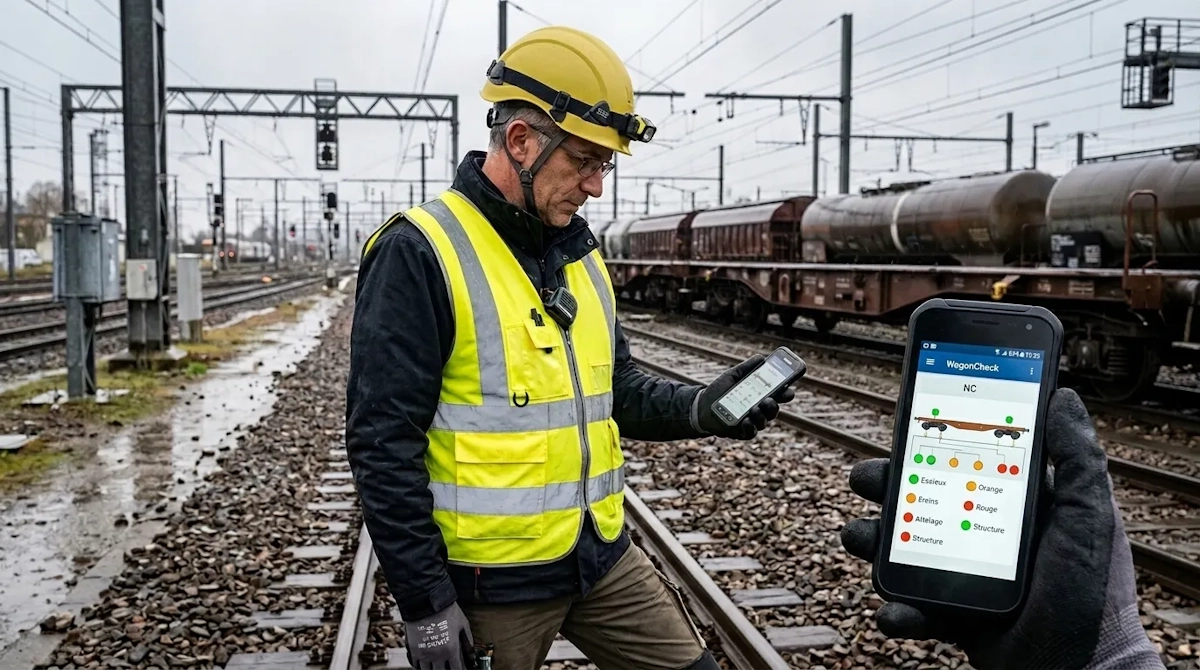
Generic form apps like MoreApp or Kizeo Forms lack visual elements that are essential for inspecting rolling rail equipment, such as interactive wagon diagrams or preconfigured parts lists. In the field, inspectors (Wagenmeister) must navigate very dense text-based dropdown menus, which slows down entry and increases the risk of errors under difficult conditions (rain, mud, work gloves). Furthermore, these tools are incapable of making the chronological link between the entry and exit condition of a wagon.
Rail inspection work requires fast and highly localized entry. When an agent detects a crack on a bogie or a deformation on the chassis of a hopper wagon, entering the exact location textually in a standard form takes time. Additionally, these apps store damage photographs in a bulk list at the end of forms without any direct, interactive link to the damaged components.
A specialized tool like WagonCheck resolves this major operational issue with interactive wagon diagrams (top and side views). The inspector places a marker directly on the affected area and assigns it a precise severity level: OK (green), To repair (orange), or To replace (red). Sentry input is immediate and intuitive, and the generated report automatically associates each photo with its corresponding marker on the diagram, providing visual clarity that is impossible to obtain with generic form grids.
How does WagonCheck solve damage management under the GCU agreement?
WagonCheck natively integrates the official Appendix 9 price list of the General Contract of Use for Wagons (GCU) to automatically calculate estimated repair costs directly from the app. Unlike generic form builders, WagonCheck performs an automated comparison of entry and exit inspections to instantly extract the damage delta. This eliminates complex manual calculations and double entries on Excel for settling claims.
The European agreement administered by the GCU Bureau sets strict financial rules regarding the division of responsibilities for freight wagon damage. Below the regulatory threshold of €850 excl. VAT, the rail company can launch routine repairs without prior agreement from the keeper. Manually calculating and verifying whether damage (brake shoe, buffer, coupler) exceeds this threshold represents a significant administrative burden.
With WagonCheck, real-time pricing is calculated automatically based on the component marked on the diagram and the selected severity. The app immediately generates an official PDF document, signed contradicly via touchscreen or validated in the event of the client's absence, ready to be sent via email (Nodemailer) to all stakeholders.
| Field & Industry Features | Generic Forms (MoreApp / Kizeo) | WagonCheck Core Solution |
|---|---|---|
| Interactive Wagon Diagrams | ❌ No (free-text entry only) | ✅ Yes (visual positioning of anomalies) |
| Integrated GCU Damage Calculator | ❌ No (external calculation or Excel required) | ✅ Yes (automatic real-time pricing) |
| Hybrid Offline Mode | Basic (frequent loss of heavy photos) | 🚀 Advanced (Modern cache + local compression) |
| Billing Model | ⚠️ Subscription per user (very restrictive) | 🚀 Unlimited users (active fleet package) |
| Asset-Centric History | ❌ No (isolated sheets without continuity) | ✅ Yes (Drive and chronological tracking per wagon) |
Why does Kizeo and MoreApp's per-user pricing block deployment on work sites?
The user-licence billing model applied by Kizeo Forms and MoreApp penalizes field deployment by forcing companies to limit app access to control costs. This model blocks collaboration with temporary subcontractors and partner workshops, harming inspection traceability. In contrast, WagonCheck offers an unlimited-user model billed on the active wagon fleet, ensuring that every field actor has their own access.
In the rail industry, tracking a work site involves multiple stakeholders: internal inspectors, train drivers, site managers, maintenance workshops, and client agents. Paying a monthly subscription of €15 to €20 per user for collaborators who only use the tool a few times a month represents an unacceptable additional cost. This often leads to safety workarounds, such as sharing a single set of credentials, which strips all legal value from electronic signatures.
WagonCheck's model relies on a flat base fee of €400.00 excl. VAT per month that includes unlimited users. Pricing adjustments are based solely on active fleet size. All teams on-site can thus be equipped at no extra cost, ensuring perfect traceability of joint wagon inspections.
How do rail operators optimize their inspections by migrating to a dedicated tool?
Rail operators and track work site managers digitize their wagon inspections by replacing legacy paper tools and generic forms with the WagonCheck solution. This transition makes it possible to unify fleet tracking on a dedicated, secure Cloud infrastructure. By connecting all field teams without user license restrictions, operators accelerate damage pricing and secure transfers of liability.
In the field, managing entry and exit inspections on generic mobile forms or paper causes frequent losses of traceability during handovers. By migrating to a dedicated SaaS instance of WagonCheck, operational teams have a centralized space to continuously track the condition of their freight and track-work wagon fleet.
Data collected in dead zones (tunnels, isolated classification yards, deep countryside) is stored locally using WagonCheck's Offline-First PWA technology, then synchronized with a single click once connection returns. This operational robustness allows maintenance teams to divide the time spent on administrative management of GCU damage by three, while securing evidence in the event of a dispute.
Conclusion
Using generic tools like MoreApp or Kizeo Forms is a first step towards going paperless, but only a specialized platform meets the specific demands of railway safety (EPSF). By choosing WagonCheck, you equip your field agents with an inspection tool that is visual, robust offline, and natively compliant with GCU agreement price lists.
Ready to eliminate billing disputes for your rail fleet? Request a demo or a custom quote by email at contact@nepo.fr.
FAQ
What are the main limitations of MoreApp or Kizeo Forms for inspecting a wagon?
Generic form apps do not have an interactive visual interface to position damage markers of varying severity (orange or red pins) directly on wagon diagrams. Nor do they integrate a database of railway components, chronological tracking of rolling stock lifecycle, or a calculator connected to the official GCU Appendix 9 list.
Why is an unlimited-user pricing model crucial for wagon inspections?
Joint wagon inspections often involve third parties (subcontractors, clients, maintenance workshop inspectors). User-based pricing pushes railway companies to restrict the number of active accounts to limit subscription costs. An unlimited-user model like WagonCheck's allows all field actors to be involved, ensuring the legal authenticity and traceability of signatures collected on tablets.
How does WagonCheck handle inspection data synchronization in dead zones?
Thanks to its Offline-First Progressive Web App (PWA) architecture, WagonCheck saves all form data locally and automatically compresses photos taken offline on the device's local storage. A status banner alerts the user and allows them to sync all records with a single click as soon as an internet connection (Wi-Fi or 4G/5G) is available again.