

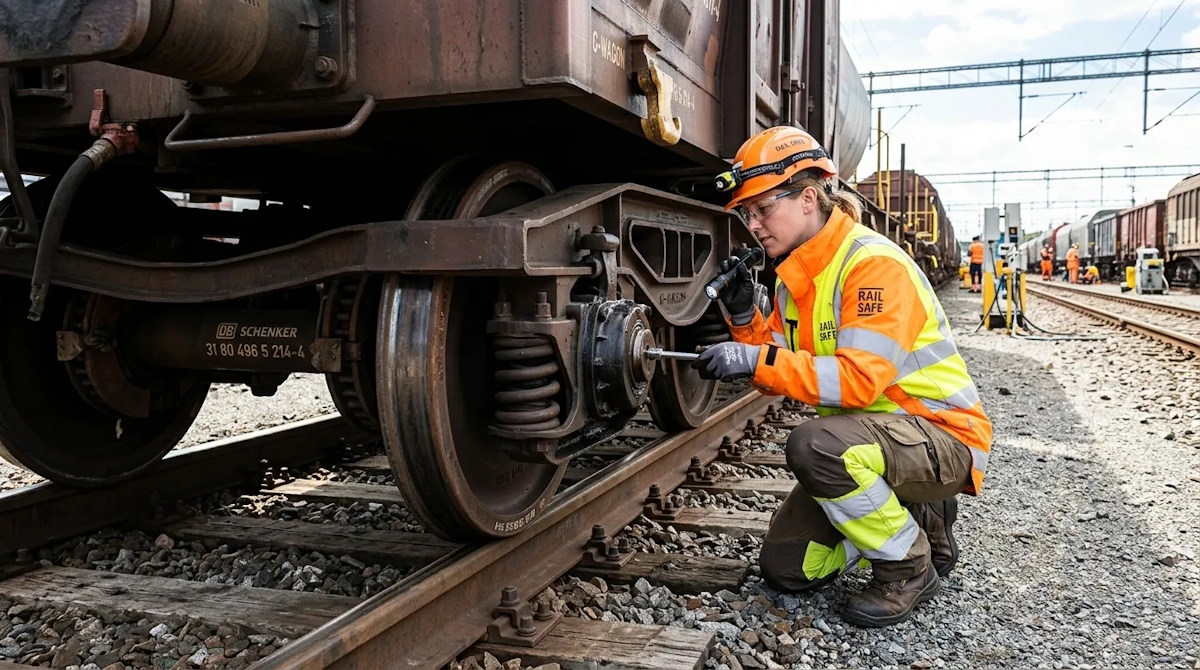
The gcu wagon damage standards constitute the essential legal and technical framework for all railway freight transport stakeholders in Europe. Regulated under the aegis of the intergovernmental organization OTIF, these rules unify relations between wagon keepers, operators, and maintenance workshops to simplify damage management on an interconnected network. Faced with frequent disputes during fleet handovers or joint inspections, understanding precisely who pays for each defective part is crucial to secure the operational margins of fleet managers.
What is the General Contract of Use (GCU) for wagons?
The General Contract of Use (GCU) is a multilateral European agreement that defines the reciprocal rights and obligations of wagon keepers and railway undertakings (RUs). It aims to simplify the international circulation of freight wagons by standardizing the rules of use, liability, and repair. The contract replaces complex former bilateral agreements with a single convention administered by the GCU Bureau.
This regulatory text ensures that any wagon can cross European borders without administrative breakdown. When a wagon is entrusted to a railway undertaking (RU) to transport goods, the RU takes technical custody of it. If an anomaly or failure occurs, the GCU dictates the procedure to restore the rolling stock to working order. The contract protects both owners against operational negligence and operators against latent defects or lack of maintenance of the wagons entrusted to them.
How is financial liability for wagon damage distributed under the GCU contract?
Under the GCU regime, financial liability depends on the nature and proof of the origin of the damage. The railway undertaking (RU) is presumed liable for damage occurring during the period the wagon is in its custody, unless it proves that the damage results from normal wear and tear or a pre-existing technical defect. The keeper is responsible for periodic maintenance and structural failures of the equipment.
The GCU contract defines clear rules for billing damage. If a wagon undergoes an impact during a shunting operation in a yard, it is an operational damage: the railway undertaking bears the financial cost. Conversely, if an axle shows fatigue cracking without proof of impact, the replacement cost falls to the keeper (the owner or lessor).
In field practice, this distinction is often a source of endless disputes. For wagon lessors like Atir-Rail or Ermewa, verifying the running gear and draw gear (bogies, axles, couplers) at each transfer of liability is critical.
As highlighted by Flavien Bouters, Technical Director & ECM Manager at Atir-Rail:
"The key under the GCU regime is traceability. Without a precise and timestamped joint inspection at entry and exit, proving the origin of damage to a bogie or a coupler is almost impossible. That is where thousands of euros in disputes are decided."
To simplify these procedures, specialized inspection software like WagonCheck allows logging the condition of each wagon with touchscreen joint signatures directly in the field, even in the rain or mud of a shunting yard.
What are the wagon inspection obligations according to the GCU contract?
The GCU contract imposes systematic technical inspections to guarantee railway safety before the departure of each train and during custody transfers. These checks aim to detect critical defects on safety components such as brakes, suspensions, and wheels. Each anomaly must be logged and classified to determine if the wagon can continue to run or must be sent to a workshop.
Inspection obligations are rigorously defined by railway safety authorities such as the Établissement Public de Sécurité Ferroviaire (EPSF) in France. Railway inspectors (Wagenmeister) check the physical condition of the rolling stock using structured inspection forms.
Particular attention is paid to the types of wagons. For example, inspecting a hopper wagon requires checking the discharge gates, while a tank wagon requires checking the sealing valves. In the field, using paper forms is a major risk factor: lost sheets, photos impossible to link to the damage report, and increased risk of disputes.
An internal study conducted on the sites of one of our major clients shows that digitizing inspection forms reduces data entry errors by 85% and saves an average of 4 hours of administration per week per field inspector. Thanks to a Progressive Web App (PWA) operating 100% offline (Offline-First), inspection data is secured locally on the device and synchronized when internet connection returns.
How to estimate the cost of damage on a wagon according to GCU tariffs?
Estimating repair costs is carried out by comparing the condition of the wagon at the entry and exit of a worksite according to the official GCU Appendix 9 grid. This grid defines standardized prices for labor and common spare parts. WagonCheck integrates these tariffs directly to automate the calculation and generate a neutral, instant damage cost estimation.
To prevent every damage from leading to endless negotiations between the railway undertaking and the keeper, the GCU has established a harmonized price list. Appendix 9 of the contract lists standard repair times and prices for usual railway components (brake blocks, couplers, buffers, etc.).
The GCU also provides an administrative simplification rule: for any damage where the estimated cost is under €850 excl. VAT, the railway undertaking can carry out or have the repair carried out immediately without requesting prior authorization from the keeper. It will then bill the amount based on GCU tariffs, provided the wagon is restored to run safely.
| Rail Damage Type | GCU Financial Liable | Prior Approval Threshold | Operational Impact |
|---|---|---|---|
| Normal wear of brake blocks | Keeper | < €850 excl. VAT (billed directly) | Routine maintenance |
| Shunting impact (frame deformation) | Railway Undertaking (RU) | No threshold (RU assumes 100%) | Workshop immobilization |
| Pre-existing bogie technical defect | Keeper | > €850 excl. VAT (agreement required) | Trainset withdrawal |
| Operational damage on work site | Railway Undertaking / User | No threshold (RU assumes 100%) | Immediate repair |
The advantage of WagonCheck's costing module is that it eliminates the tedious use of complex Excel files by automatically applying the correct price lists according to the wagon category (flat wagon, hopper wagon, tank) and the severity of the anomaly entered on the interactive plan (orange dot 'to repair', red dot 'to replace'). This ensures total transparency during joint inspections.
Why abandon Excel for GCU damage dispute management?
Manual management of GCU damage on Excel exposes fleet managers to data loss, a lack of traceability of damage photos, and frequent billing disputes. Dedicated SaaS software centralizes equipment history and automates costing for quick settlement of claim files.
Many rail freight SMEs and track works companies (in their early days) manage their wagons on shared spreadsheets. Yet, according to industry statistics, 40% of damage invoice disputes stem from a lack of clear photographic evidence or failed chronological tracking.
By centralizing worksite history and inspections on a single platform, our clients' maintenance teams reduced their administrative dispute processing time by 70%. Additionally, our business model with unlimited users allows connecting all field agents (inspectors, site managers, workshops) at no extra license cost, promoting real-time information feedback.
Conclusion
Compliance with GCU wagon damage standards and the rigor of joint inspections are the two pillars to reduce railway maintenance costs and eliminate invoicing disputes. By digitizing your joint inspections with a tool like WagonCheck, you secure your transfers of liability and automatically and neutrally apply the official Appendix 9 price list.
Ready to simplify your inspections and automate your damage costing? Discover our solution and request a custom demonstration directly on our website.
FAQ
Who is responsible for damage caused during a derailment?
Under GCU contract rules, if the derailment is attributable to an infrastructure defect or a railway operation error, the operating railway undertaking (RU) bears the full cost of material damage. However, if the derailment is caused by an inherent technical defect in the wagon (e.g. axle failure due to metal fatigue without operational fault), financial liability falls on the wagon keeper.
What is Appendix 9 of the GCU contract?
Appendix 9 of the GCU is the technical reference document that sets out the conditions for restoring wagons to service, as well as the catalog of standardized prices for spare parts and labor. It is on this official price grid that RUs and maintenance workshops rely to repair and invoice routine damage with a unit cost below the regulatory threshold of €850 excl. VAT.
How to prove liability for damage on a wagon?
Proof of liability relies entirely on chronological comparison of the rolling stock's condition. Carrying out a joint inspection at handover (upon entry into the custody of the RU or lessee) and a joint inspection at return (upon exit) signed by both parties constitutes the only legally binding proof under the GCU agreement to allocate damage that occurred during operations.